


WHICH LEATHER TO CHOOSE?
The choice of leather must be made according to the creation to be realized. Each animal has its own particularities in terms of flexibility, thickness, or surface area of the hide. It is important to note that every hide is unique and that the mechanical properties of the leather are therefore not identical across the entire surface (particularly for bovine leather). Leather is a durable material used in many sectors: leather goods, clothing, saddlery, glove making, footwear... It is an inimitable and timeless material. Discover in this guide the different tanning processes, leather finishes, and the specific characteristics of each animal.
We invite you to view the campaign by Alliance Cuir: "Nothing imitates leather as well as leather." As indicated above, leather is inimitable and, by definition, can only be of animal origin. All the substitutes that are emerging ("pineapple leather," mushroom, apple, cactus leather...) will never be able to replace this noble material.
WHERE TO BUY LEATHER?
Find the ideal leather for your next creation among our wide range of leather hides in varied colors and diverse finishes. Our goal is to offer quality leathers accessible to everyone.
WELCOME TO THE WORLD OF LEATHER
50% OF OUR LEATHERS COME FROM STOCK CLEARANCE
We uncover for you leathers from end-of-series or old collections of major leather goods manufacturers, shoe brands, or luxury brands to offer them to you for sale. This is why most of our leathers are offered in limited series, and this is also what allows us to offer you affordable prices. Without knowing it, you add a "responsible" touch to your creations by helping us recycle this beautiful material - UPCYCLING.
50% OF OUR LEATHERS ARE MANUFACTURED FOR YOU
In order to offer you permanent ranges and allow you to make some of your creations sustainable, we have our own ranges of leather manufactured: Nappa calf, Velvet, Sauvage, Sweet 2, Automotive... OUR LEATHERS PRIMARILY COME FROM EUROPEAN TANNERIES.
 |
 |
 |
| LEATHER HIDES | LEATHER PIECES |
LEATHER SCRAPS |
THE DIFFERENT TANNING METHODS
Tanning consists of transforming skin into leather using tannins, substances of various natures that allow a putrescible skin to be turned into a non-putrescible material: leather (source: Alliance France Cuir).
Leather is a durable material used in many sectors: leather goods, glove making, footwear, textiles, saddlery... It is an inimitable and timeless material. The term "leather" can only be used when an animal skin has been transformed.
|
VEGETABLE TANNING |
MINERAL TANNING (CHROME) The most common method because approximately 85% of leathers are mineral tanned and therefore require little maintenance. Uses mineral tannins: chrome salts, iron salts... The rise of this tanning method is primarily due to customer demand, as they do not accept that a leather bag should be ruined by rain. This eliminates the need for regular maintenance. |
 |
 |
COMBINED TANNING
Tanning that combines 2 tanning families to obtain a leather that adds together the qualities of the tannins used. For example: Chrome-Vegetable.
SYNTHETIC TANNING
Uses synthetically produced tannins. The composition is close to that of vegetable tannins.
TANNER OR CHAMOISER?
The material is worked in a tannery for bovine leather and in a chamoisery/tawery for goat and sheep leather.
- The tanner works with large raw hides (calf, young bovine, cow, heifer, bull, buffalo).
- The chamoiser prepares smaller, thinner hides (lamb, sheep, goat, ostrich).
The different parts of a bovine hide
Discover our guide which presents the different parts of a bovine hide as well as their respective qualities.

HOW DO I KNOW IF MY LEATHER IS VEGETABLE OR MINERAL (CHROME) TANNED?
We invite you to watch the video (below) from the Radermercker tannery which explains the flame test technique.
This technique consists of burning a piece of your leather: if the ashes are greenish, it is a mineral tanning.FIND THEIR LEATHERS ON OUR SITE >
WHAT IS LEATHER AND HOW IS IT MADE?
Several manufacturing steps are necessary in order to transform a hide into leather: beamhouse work (preparation for tanning), tanning, dyeing, and currying/finishing. To learn more about each step, we invite you to consult the complete guide from the National Leather Council (Conseil National du Cuir).
LEARN MORE >
 |
 |
| ©Noémie DAVAL - National Leather Council | ©Noémie DAVAL - National Leather Council |
To learn more, we invite you to view the video by "Les tanneurs français" (The French Tanners).
THE LAYERS OF A HIDE
- The epidermis, the outer side that is directly exposed to external aggressions.
- The dermis, which is the part consisting of living cells, organized into a condensed tissue; it is the birthplace of hairs and nerve endings.
- The hypodermis, this is a zone of fat cells; it is a loose layer, and it is in direct contact with the body's muscles.
Leather is made only from the dermis of the hide.

THE MAIN LEATHER FINISHES
 |
 |
 |
 |
|
FULL-GRAIN LEATHER Leather that has retained its original grain (intact outer layer). It is the "noblest" leather in the leather family. |
SPLIT LEATHER Leather from which the grain has been removed by splitting. |
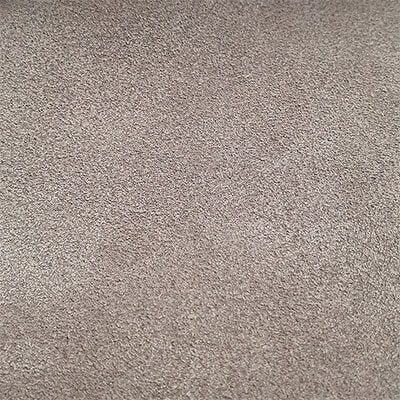
SUEDE SPLIT Product with a velvety appearance obtained from a split. |
COATED LEATHER / SPLIT Leather / Split covered with a thick surface finish. The leather has received a finish based on polyurethane (PU). |
 |
 |
 |
 |
|
PATENT LEATHER Leather coated with a layer of varnish or a film (waterproof). |
CORRECTED-GRAIN LEATHER Leather whose grain has undergone light sanding to eliminate defects. It will receive various finishes: pigmented, grained... |
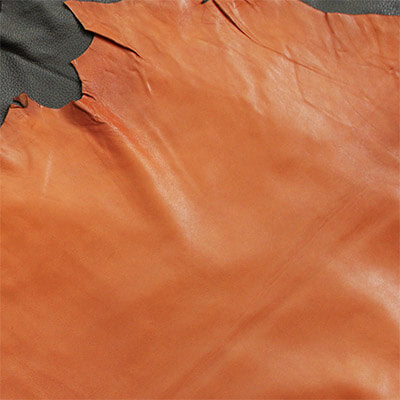
NATURAL LEATHER Leather that has no surface finish. |
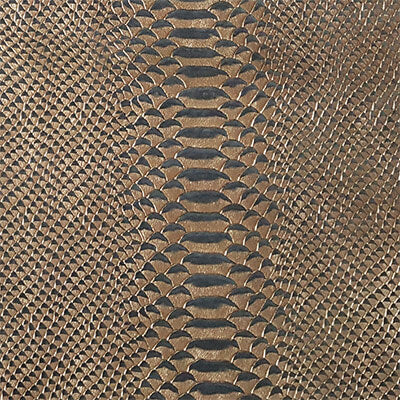
FANCY LEATHER Leather with an original finish: metallic, imitation croc, snake... |
 |
 |
 |
 |
|
GRAINED LEATHER** Leather that has undergone a graining operation by a tanner (not natural). |
NAPPA LEATHER Soft, smooth, thin, and resistant full-grain leather from lamb, calf hides, etc. |
VELVET LEATHER* Leather with a velvety appearance obtained by sanding the flesh side (split - opposite of nubuck). |
NUBUCK LEATHER Leather with a velvety appearance obtained by sanding the grain. Nubuck is a high-end leather: "a peach skin." |
A LITTLE VOCABULARY...
 |
 |
 |
|
GRAIN (FLEUR) This is the front side of the leather: the side of the hide that supports the hair. It is smooth, grained, velvet... |
FLESH SIDE This is the back of the leather; it is rather fuzzy. |
EDGE This is the side of the leather. The edges can be worked with a gum or edge finish. |
WHAT IS DRUM-STUFFED (FOULONNÉ) LEATHER?
Drum-stuffed leather is leather that has been processed in drums (tanning drums) to be softened (a sort of large washing machine that works dry and sometimes with hot air). This operation can last several hours depending on the flexibility of the leather one wishes to obtain.
*WHEN DO WE TALK ABOUT VELVET (VELOURS)?
Unlike Nubuck, velvet leather is sanded on the flesh side. This leather has a more fibrous structure than nubuck. It is sometimes called suede*. It is generally manufactured from hides that have defects on the grain, in order to transform the back of the hide into velvet leather to add value to it. In this case, the grain side remains in its original state, with its defects, because only the velvet side will be visible in the created item. Velvet leather can also be made from leather splits. In this case, one side will be velvet, and the other can be either raw or velvet. Generally, velvet leather is quite flexible. This leather is readily used for making linings, gussets, flexible items like pouches, work shoes, or gloves. This leather is more economical than full-grain leathers.
*It is important to remember that "suede" leather does not exist - the deer (daim) is a protected species.
 ©Noémie Daval - National Leather Council
**WHAT IS GRAINED LEATHER?
First, one must differentiate naturally grained leather, which will have grain variations depending on the parts of the hide, from leather that has undergone pressure treatment and has a very uniform grain on the grain side. Leather is artificially grained to embellish it and give it a personalized style.
Major luxury leather goods brands have created their "own grain" to provide a signature to their items. These grain patterns are registered and must not be counterfeited by leather manufacturers.
Artificially grained leather is inherently sturdy because these created grains reinforce the leather's grain side. With use, scratches and small scuffs will be less visible than on smooth leather. This leather is therefore generally used for the manufacture of bags, sofas, car seats, or shoes.
 ©Noémie Daval - Conseil National du cuir
SURFACE FINISHES
After the dyeing process, the leather receives a surface finish (a more or less thick film) intended to protect and embellish the material. This finish is chosen according to the quality of the hide.
WHAT IS ANILINE / VAT-DYED LEATHER?
This type of finish is reserved for full-grain leathers without imperfections: it involves immersing the leather in a bath to dye it throughout (vat dyeing). This type of leather retains a silky/waxy feel and will develop a patina over time. The leather maintains its natural appearance. Aniline leather is leather without any additional finish; it is more sensitive to stains and friction. It may sometimes receive a thin transparent layer (low thickness) that does not alter the properties of the hide and helps to preserve it (minimal protection). These components can be based on casein, plasticized shellac, or albumin, for example.
WHAT IS SEMI-ANILINE LEATHER?
Semi-aniline leather has received a lightly pigmented protective layer (allowing it to resist sun and bad weather). This leather is vat-dyed and covered with a light pigmented layer (also called semi-pigmented leather) and a protective layer (aniline). The imperfections of the leather will be slightly masked.
Nappa leather is a smooth, full-grain, semi-aniline leather: it has received a surface treatment and is pigmented. It is a supple and robust hide.
WHAT IS PIGMENTED LEATHER?
Pigmented leather is leather that has received several layers of opaque dyes that mask imperfections, thus making it more resistant. This type of leather often has a glossy appearance. The finish masks the defects of the grain while enhancing the grain's color.

WHAT ARE FIRST AND SECOND CHOICE LEATHERS?
Leather is a natural material that includes imperfections such as scars, wrinkle marks, holes, etc. These defects can be positioned anywhere on the hide (each hide is unique). Leather hides sold as first choice may therefore contain some defects, but they are usable over at least 75% of their surface area. There are no major defects preventing the manufacture of a piece using at least 50% of the hide's surface.
Second choice leathers are hides/pieces that may have: deep creases, small imperfections, wrinkles, scars, scratches, small holes, or stains. These leathers exhibit more defects than first-choice leathers, and these defects can be distributed across the entire hide. The hides are usable over at least 50% of their surface area. These hides are intended for the manufacture of small parts that can be positioned around the defects in order to make the best use of their surface.
SEE SECOND CHOICE LEATHERS >
THE DIFFERENT ANIMALS
The most commonly used leathers:
-
Bovine: calf, cowhide, yearling, bull, bison...
The most widely used; large size, supple or firm for leather goods, furniture, and the footwear industry.
What are the differences between cowhide and calf leather?
Cowhide refers to adult bovine (cow, ox, and bull). This leather is rather firm and resistant. Ideal for making handbags, luggage, belts...
Calf leather is more supple than cowhide and is particularly favored in luxury leather goods.
-
Ovine: lamb, ewe, sheep
Supple leather, very small and smooth grain, small-sized hide, mainly for clothing, jewelry, luxury goods, and footwear. Sheep can be worked while keeping its wool.
-
Caprine: goat, kid, billy goat, chamois, deer, caribou...
Leather is somewhat firm (unless drum-stuffed), specific grain (naturally quite marked), small-sized hide, mainly for leather lining, leather goods, and footwear.
-
Porcine: pork, pig, peccary...
Entry-level leather. Specific grain: leather goods lining, gloving.
Exotic leathers:
-
Reptilian: iguana, crocodile, alligator, caiman, lizard, chameleon...
Small hide and very regular scales. The cost is very high, which limits its use to luxury items.
-
Snakes and water snakes: python, boa...
Fragile hides requiring reinforcement or lining, used in leather goods and footwear.
-
Fish: Nile perch, salmon, shark, dogfish...
Relatively small and thin hides. A sector that has been trying to develop for some years. Galuchat (shagreen) is a fish leather. Galuchat skin leather is unique and very hard. It consists of small mineral beads that give it a very particular grain. This leather is also characterized by its central pearl, often white in color, which is highly coveted.
-
Various exotic animals: ostrich, kangaroo...
Ostrich skin is the most worked of this family, especially appreciated for its appearance with its quills, which are the marks of the feathers. Ostrich leg is also appreciated for its scaled appearance. It is widely used for small leather goods or watch straps.
 |
 |
 |
 |
 |
| Furniture | Jewelry | Footwear | Decoration | Gloving |
 |
 |
 |
 |
| Leather Goods | Clothing | Bookbinding | Saddlery |

This guide is provided for information purposes; one must of course take into account the specificities of each hide (notably suppleness and thickness). Leather is a noble material composed of small defects (scars, marks, shade differences...) which only remind us that the material is also alive.
HOW DO WE MEASURE THE SURFACE OF OUR LEATHER HIDES?
The surface of a hide can be measured in m² or ft² (square footage). The oldest unit of measurement is the foot: which corresponds approximately to the size of a human foot (1 foot = 0.3048 m - 1 ft² = 0.0929 m²). For simplicity, we have chosen to provide you with measurements in m², so the price of our leathers is based on this measurement.
HIDE DIMENSIONS TABLE
 In order to help you in choosing the hide size (in m²), we provide you with a table with values in cm. Please note that this table is provided for information purposes to give you a rough idea but does not take into account all the specificities of each hide (specific to each animal). The given dimensions correspond to the size of a rectangular piece that can be cut from the hide (the head, flanks, and legs are not included in the measurements). The dimensions are approximate. For a very specific project, do not hesitate to contact us so that we can verify the dimensions.
| From 0.10 to 0.20 m² | From 0.20 to 0.30 m² | From 0.30 to 0.40 m² | From 0.40 to 0.50 m² | From 0.50 to 0.60 m² | |
|
SIZE IN CM |
30 x 40 cm | 30 x 45 cm | 35 x 50 cm | 40 x 50 cm | 45 x 60 cm |
| From 0.60 to 0.70 m² | From 0.70 to 0.80 m² | From 0.80 to 0.90 m² | From 0.90 to 1 m² | From 1 to 1.10 m² | |
|
SIZE IN CM |
50 x 60 cm | 45 x 70 cm | 60 x 75 cm | 60 x 80 cm | 65 x 85 cm |
| From 1.10 to 1.20 m² | From 1.20 to 1.30 m² | From 1.30 to 1.40 m² | From 1.40 to 1.50 m² | ||
|
SIZE IN CM |
65 x 90 cm | 75 x 100 cm | 75 x 110 cm | 75 x 120 cm |
HOW DO WE MEASURE THE THICKNESS OF OUR LEATHERS?
The thickness of leather is measured with a gauge. We offer leather thicknesses ranging from 0.5 to over 3 mm. The thicknesses of leather pieces can vary by plus or minus 0.3 mm.

CHOOSING THE THICKNESS OF LEATHER
Depending on the animal (and its age), leather can have a maximum thickness of about 2 mm for goat and lamb leathers and 6 mm for bovine. Then, each tanner can thin the leather with machines to decrease its thickness and thus meet their customers' demand. Generally, the minimum thickness is around 0.5 mm. You should know that the thinner the leather, the more it will be subjected to deformation. The choice of leather thickness for your creations depends on many factors (technical and aesthetic).
HOW TO CARE FOR LEATHER?
Leather is a living material that time patinates and beautifies. To respect this noble material and preserve its beauty, it must be maintained regularly. It is important to protect leather from water, dirt, sunlight (to avoid color changes), and heat (risk of cracking). For this, you need a colorless waterproofing spray (solvent-free – water-based), a glycerin soap to clean the leather, and a nourishing milk or grease to condition and protect the material. Please note that not all leathers are maintained in the same way. For example, suede and nubuck are very fragile, and their maintenance is limited to the use of a soft brush or a crepe brush (leather eraser) to rub away imperfections. It is also essential to waterproof them, just as with vegetable-tanned leather and aniline lambskin. Mineral-tanned leather requires little maintenance due to the substances used during its processing. Widely used and known to all, shoe polish should only be applied to footwear because it clogs the leather's pores and prevents it from breathing (risk of cracking).
REQUEST SAMPLES

UNSURE ABOUT THE COLOR OF A LEATHER, LACE, OR STRAP?
To get an idea of the color, thickness, and suppleness of the leather we sell in full hides, we offer to send samples. We also offer samples for our leather straps and laces.




91 comments
Anonymous
Bonjour Jean-François,
Pour un collier pour chien il faut privilégier un cuir tannage végétal d’au moins 3 mm d’épaisseur : https://www.decocuir.live/morceau-cuir-tannage-vegetal-c102x2677112
En ce qui concerne « l’estampillage », celui-ci pourra être fait avec des matoirs alphabets : https://www.decocuir.live/jeux-de-matoirs-3d-c102x3750772
Je vous invite à aller voir le guide suivant : https://www.decocuir.live/matoir-guide-cuir-frapper-droit-video-c1200x67002
Enfin, pour la bouclerie, privilégiez de l’INOX 😉
Bonne journée,
L’équipe Deco Cuir
Anonymous
Bonjour, j’aimerais confectionner un collier pour mon chien. Il dois être très résistant (un molosse de 140 lbs) et j’aimerais tentez mes premier pas en maroquinerie. Je veux pouvoir faire des gravures, des estampillages, teintures (facultative) et que le collier sois sans entretien. Quel cuire et de quel épaisseur pourrais convenir a mon projet ?
Anonymous
Bonjour Corinne,
Pour une selle de moto nous vous conseillons de sélectionner un cuir de sellerie automobile : https://www.decocuir.live/peau-cuir-sellerie-automobile-ameublement-c102x2387898
Vous pouvez demander jusqu’à 3 échantillons de cuir en commandant l’article suivant (0,90 € – frais de port compris) : https://www.decocuir.live/demande-d-echantillon-3-cuirs-max-c2x18058882
Bonne journée,
L’équipe Deco Cuir
Anonymous
Bonjour !!
je souhaite refaire ma selle de moto en cuir que me conseillez vous ? Comment puis je avoir un échantillon pour vérifier la couleur (plutôt fauve ou alezan).
Merci pour votre réponse.
Anonymous
Bonjour Laetitia,
Pour une sacoche de vélo, nous vous conseillons soit un cuir tannage minéral de notre gamme SATINLYS (peaux : https://www.decocuir.live/peau-veau-satinlys-c102x3811968 ou morceaux : https://www.decocuir.live/cuir-veau-morceaux-qualite-satinlys-c102x2625168). Soit un cuir tannage végétal (1,6 ou 1,9 mm d’épaisseur) : https://www.decocuir.live/morceau-cuir-tannage-vegetal-c102x2677112 (existe aussi en peaux).
Pour les poignées de vélo, effectivement le cuir automobile serait l’idéal (c’est ce type de cuir qui est utilisé pour gainer les volants). Sinon vous pouvez aussi choisir un cuir tannage végétal mais il faudra bien l’imperméabiliser, l’avantage de ce type de cuir est qu’il se patinera avec le temps !
L’équipe Deco Cuir
Anonymous
bonjour
pour faire une sacoche à vélo qui sera à cheval sur la barre, que me conseillez vous? et pour faire les poignées du vélos en cuir ce serait du cuir automobile ?
merci de votre aide!!
Anonymous
Bonjour,
Pour remplacer le cuir de votre ancien secrétaire nous invitons à sélectionner un cuir d’ameublement (qui est traité anti rayures) ou un cuir de veau/vachette de 0,8 – 1 mm d’épaisseur (en fonction du résultat souhaité).
Cuir ameublement : https://www.decocuir.live/peau-cuir-automobile-anti-uv-humidite-protege-c102x2387898
Cuir de veau : https://www.decocuir.live/peau-cuir-veau-souple-c102x2664031
Cuir de vachette : https://www.decocuir.live/peau-cuir-vachette-c102x2664033
Il faudra ensuite coller le cuir avec une colle pour cuir (base aqueuse) : https://www.decocuir.live/cuir-colle-diuant-neoprene-fort-c102x2229518
L’équipe Deco Cuir
Anonymous
Bonjour,
Je souhaite remplacer le cuir d’un ancien secrétaire. J’avoue être un peu perdue ! Pouvez vous me conseiller sur le choix d’un cuir et l’épaisseur ?
Dans l’attente de votre réponse,
Bien cordialement,
Anonymous
Bonjour,
Le cuir conseillé pour faire un bracelet en cuir est un cuir tannage végétal : https://www.decocuir.live/morceau-cuir-tannage-vegetal-c102x2677112 Il faudra choisir l’épaisseur en fonction de l’épaisseur maximum acceptée par votre Scanncut, l’idéal serait un cuir de 1,9 cm.
Nous proposons aussi déjà des découpes de bracelets en cuir : https://www.decocuir.live/diy-bracelets-en-cuir-c102x3632722
Bonne journée,
L’équipe Deco Cuir
Anonymous
bonjour,
quel cuir et épaisseur dois je prendre pour faire un bracelet que je vais découpé à la scanncut ?
Anonymous
Bonjour François,
Merci beaucoup pour votre commentaire sur notre blog ! Pour refaire des poignées de moto nous vous conseillons le cuir automobile qui est aussi utilisée pour la sellerie auto et faire les volants. Ce cuir est traité contre l’humidité et est anti-UV et très résistant :
https://www.decocuir.live/peau-cuir-automobile-anti-uv-humidite-protege-c102x2387898
L’équipe Deco Cuir
Anonymous
Bonjour,
Je découvre votre site… Superbe !!
J’aimerai savoir quel cuir utiliser pour me refaire mes poignées de moto ? Sujet à la chaleur, frottements, pluie et emploi régulier du véhicule;
Merci pour votre réponse.
Anonymous
Bonjour Delphine,
Nous vous conseillons un cuir de veau ou de vachette ferme voire mi-ferme avec une épaisseur d’au moins 1,2 mm. Voici des références de cuir qui pourront convenir : https://www.decocuir.live/peau-veau-satinlys-c102x3811968 et https://www.decocuir.live/peau-de-cuir-de-veau-imitation-serpent-marron-c2x31941146
Bonne journée, l’équipe Deco Cuir
Anonymous
Bonjour,
Je souhaiterai me faire un beau sac à main type cabas en cuir épais couleur cognac. Que me conseillez-vous comme cuir?
Merci d’avance
Anonymous
Bonjour Manuelulu,
Pour la réalisation de mini-chaps, je vous invite à choisir un cuir tannage végétal épais (au moins 1,5 mm d’épaisseur) mais souple type basane : https://www.decocuir.live/peau-entiere-de-cuir-de-basane-france-antique-vintage-chocolat-065-m-c2x28742734
Je vous laisse aussi aller voir notre gamme de cuir tannage végétal : https://www.decocuir.live/peaux-cuir-tannage-vegetal-c102x2664027
Justine de Deco Cuir
Anonymous
Bonjour,
Quelle peau me conseillez-vous pour réaliser des mini-chaps (haut de botte pour protéger les mollets du frottement des étrivières, sangles des étriers, quand on monte à cheval)?
D’avance merci!
Anonymous
Bonjour Benoit,
Effectivement nous vous conseillons de choisir un cuir de basane (tannage végétal) : https://www.decocuir.live/peau-cuir-agneau-basane-france-c102x2227515
Bonne journée !
L’équipe Deco Cuir
Anonymous
Bonjour, merci pour cette rubrique intéressante !
je souhaite recouvrir un fauteuil ancien en cuir type “fauteuil club”
Je partais sur du mouton pleine fleur mais est ce le bon choix ?, que me conseillez vous ?
Anonymous
Bonjour Pascale,
Effectivement, pour réaliser ce type de fauteuil en cuir nous invitons à sélectionner un cuir tannage végétal naturel en 1,9 mm d’épaisseur : https://www.decocuir.live/peaux-cuir-tannage-vegetal-c102x2664027
Nous serons ravis de voir le résultat !
Bonne journée et bonne année 2021. L’équipe Deco Cuir
Anonymous
Bonjour,
je désire réaliser une chaise de type “Muller van severen chair”
Quel épaisseur de cuir dois-je acheter pour l’assise ? Et quel cuir ? Je pensais acheter du cuir collet végétal naturel ?
Merci
Pascale
Anonymous
Bonjour,
Tout d’abord merci pour votre commentaire. Je vous invite à aller voir les deux fiches articles suivantes afin d’avoir des idées de créations réalisés avec une croûte de cuir ou une peau de cuir verni : https://www.decocuir.live/peau-de-croute-de-cuir-enduite-grain-dauphin-bleu-marine-b61-095-m-c2x31195176 et
https://www.decocuir.live/peau-cuir-veau-crocodile-sac-maroquinerie-imitation-c2x32591923
Au vue de l’épaisseur du cuir vous pouvez réaliser tout type de création de maroquinerie (pochette banane, trousse en cuir, pochette en cuir, porte-monnaie…) je vous invite à aller voir les tutoriels de notre blog : https://www.decocuir.live/Blog.asp?CatID=3805504
Enfin, vous pouvez bien sûr nous retourner la peau (délai de rétraction de 14 jours) en complétant le formulaire de retour : https://www.decocuir.live/formulaire-retour
Bonne journée et bonne année 2021 ! L’équipe Deco Cuir
Anonymous
Bonjour à tous .
Votre site est très bien conçu.
Pourriez-vous m’aider à prendre une décision sur un projet qui pour moi sera difficilement réalisable : Je m’explique : Je me suis procurée du cuir verni vert jade .
Pourriez-vous me dire ce que je pourrais réaliser avec ?Quelques idées de réalisation me permettraient de l’utiliser à bon escient ..
Sinon, pourrais-je vous le renvoyer ?
Très bonne continuation…
Merci.
Anonymous
Bonjour Fabienne,
Pour la création d’un marque page nous vous conseillons de sélectionner un cuir tannage végétal déjà teinté ou naturel avec une épaisseur d’au minimum 1,6 mm : https://www.decocuir.live/morceau-cuir-tannage-vegetal-c102x2677112
Bonne journée,
L’équipe Deco Cuir
Anonymous
Bonjour,
Quelle cuir pour la création d’un marque page ?
Anonymous
Bonjour Béatrice,
Nous vous invitons à choisir un cuir souple de vachette de la gamme Sweet 2 ou Granite. N’hésitez pas à aller voir notre page tutoriel avec toutes les explications : https://www.decocuir.live/tutoriel-chaussons-cuir-bebe-patron-c1200x68243
Bonne journée,
L’équipe Deco Cuir
Anonymous
Bonjour
Quel cuir utiliser pour réaliser les fameux petits chaussons pour bébé et enfants et…adultes aussi.
Cuir pour la réalisation du chaussont et pour la semelle
Merci d’avance
Anonymous
Bonjour Bouy,
Pour refaire un volant de voiture, nous vous conseillons de choisir un cuir automobile (traité anti UV et contre l’humidité) : https://www.decocuir.live/peau-cuir-automobile-anti-uv-humidite-protege-c102x2387898
Bonne journée,
L’équipe Deco Cuir
Anonymous
Bonjour
Quel cuir utiliser pour refaire un volant ?
Anonymous
Bonjour Salvatore,
Je vous invite à sélectionner un cuir tannage végétal d’une épaisseur de 3,3 mm minimum : https://www.decocuir.live/cuir-de-collet-vegetal-naturel-premium-20-x-30-cm-ep-33-mm-c2x3095061
N’hésitez pas à aller voir notre guide complet sur l’affûtage des outils : https://www.decocuir.live/strop-affuter-outil-travail-cuir-couteau-c1200x67000
L’équipe Deco Cuir
Anonymous
Bonjour,
J’aimerai du cuir à aiguiser dans un morceau de 20/30 cm. Quoi prendre ?
Anonymous
Bonjour Daniel,
Pour fabriquer une protection en cuir pour ouvrir les huîtres, je vous invite à sélectionner un cuir tannage végétal de 2,5 mm d’épaisseur : https://www.decocuir.live/cuir-de-collet-vegetal-naturel-premium-20-x-30-cm-ep-25-mm-c2x3454826$
Aussi, nous essaierons de réapprovisionner dans les prochaines semaines notre kit dédié : https://www.decocuir.live/kit-protection-ouvre-huitres-tutoriel-montage-tuto-diy-cuir-c2x24743533
L’équipe Deco Cuir
Anonymous
Bonjour,
S’il vous plait, quel cuir acheter pour fabriquer une protection en cuir pour ouvrir les huitres.
Merci beaucoup.
Anonymous
Bonjour Sarah,
Le cuir idéal pour avoir des lanières de sacs résistantes est le cuir tannage végétal d’au moins 1,9 mm d’épaisseur.
L’une des meilleures parties du cuir de bovin pour créer ces propres lanières est le collet : peau située au niveau du cou de l’animal.
Le cuir tannage végétal naturel peut-être teinté : https://www.decocuir.live/peaux-cuir-tannage-vegetal-c102x2664027
Bonne journée,
L’équipe Deco Cuir
Anonymous
Bonjour,
J’aimerais savoir quel type de cuir utiliser pour faire des sangles de sacs. J’ai le trusquin et plutôt que d’acheter des sangles j’aimerais pouvoir les couper moi-même dans un grand morceau pour faire des bandes d’environ 50 cm de long et d’une épaisseur d’environ 3mm.
Merci d’avance pour votre retour
Anonymous
Bonjour Arthuys,
Pour répondre à votre question sur notre blog, le cuir idéal pour un dessus de bureau est le cuir d’ameublement : https://www.decocuir.live/cuir-automobile-souple-morceaux-piece-anti-uv-anti-humidite-c102x1090068 que vous venez ensuite coller avec du double face ou de la colle néoprène : https://www.decocuir.live/pot-de-250-ml-de-colle-neoprene-extra-liquide-avec-pinceau-integre-au-bouchon-c2x3094948
Malheureusement nous ne vendons pas de morceaux selon vos mesures souhaitées : il faudrait donc opter pour une peaux de cuir d’ameublement ou automobile (au minimum 0,70 à 0,80 m2) : https://www.decocuir.live/peau-cuir-automobile-anti-uv-humidite-protege-c102x2387898
Bonne journée,
L’équipe Deco Cuir
Anonymous
bonjour
pouvez vous m’indiquer quel cuir en qualité il faut coller sur un secrétaire (meuble ancien)?
Vendez vous du cuir découpé au millimètre près (en l’occurrence 68,8 × 41,4 cm)?
merci
Anonymous
Bonjour Jean-Paul,
Afin de remplacer votre col en denim sur votre blouson, nous vous conseillons d’opter pour du cuir velours ou nappa avec une épaisseur d’au moins 0,8 mm. Il faudra ensuite rembourrer votre col avec de la ouatine.
Voici les catégories :
https://www.decocuir.live/peau-cuir-agneau-nappa-lisse-c102x2392093
https://www.decocuir.live/peau-cuir-doublure-c102x3752899
Bonne journée et à très bientôt,
Bien cordialement,
L’équipe Deco Cuir
Anonymous
Bonjour,
Je souhaite faire un col en cuir pour remplacer celui en denim (usé) d’un blouson.
Quel cuir choisir ?
Animal, épaisseur, souplesse etc …
Je vous remercie.
Cordialement.
Anonymous
Bonjour Marie-Cécile,
Pour faire des poignées en cuir pour vos commodes nous conseillons de choisir des lanières de collet : elles sont très résistantes et qualité premium. Elles sont aussi proposées en différentes longueurs, largeurs et épaisseurs : https://www.decocuir.live/laniere-sangle-ceinture-cuir-collet-vegetal-c102x2679725
Enfin, nous vendons aussi des poignées en cuir « prêtes à l’emploi » : https://www.decocuir.live/poignee-cuir-porte-tiroir-commode-sangle-laniere-c2x23468247
Nous vous conseillons pour travailler les tranches et aussi « protéger » l’arrière (côté croûte) de vos poignées de mettre de la gomme adragante. Je vous invite à lire la fiche article ou regarder la vidéo pour savoir comment l’utiliser : https://www.decocuir.live/gomme-adragante-finition-tranche-cuir-tannage-vegetal-c2x18625601
Bonne journée,
Justine de Deco Cuir
Anonymous
Bonjour
J’aimerais faire des poignées de commode en cuir
Pourriez-vous m’aider à choisir ?
Merci
Anonymous
Merci pour cet exposé clair et instructif pour les novices.